Posts

Societal Regression and some theory behind it....

For a few years I have been thinking about Murray Bowen's Family Systems theory concept of societal regression. Bowen studied families of schizophrenics and recognized intergenerational patterns of emotional transmission, patterns in which certain family members carried the dis-ease of the family and the ways that other family members participated in that transmission process. From these studies he developed his family systems theory which, for those of us who study and apply it, emphasizes personal accountability by taking clearly defined, principled stands based on one's values and belies. Taking these stands however is not done to defend or justify and certainly not to diminish another. One does this simply to be less anxious because one is being mature. Bowen called this, "Self-differentiation." Clearly defined people fall on a spectrum from 1-10, with one being less defined and 10 being fully defined, and no one is ever a 10, except maybe Jesus. Most of us are ...

You will always have me...

Image
On Ash Wednesday we are invited to observe a Holy Lent by taking on a series of practices including: prayer, fasting, repentance, meditating on God’s holy Word, self examination, and self denial. Last week I spoke about self examination as we reflected on the reading in the Gospel of Luke known as the Prodigal Son. This week let’s look at this reading from the Gospel of John when Jesus has dinner at the home of Mary, Martha, and Lazarus in Bethany.  Just a little bit earlier in the story Jesus was summoned to Bethany by Mary and Martha because their brother Lazarus was ill and dying. But Jesus delayed his trip to Bethany and Lazarus died. When Jesus finally arrived Lazarus had been dead for four days and Mary and Martha were furious with Jesus and deeply grieving. Jesus became remorseful, and weeping, he asked the people to roll back the stone that blocked the tomb where Lazarus lay. Mary and Martha protested, the stench of the dead would be great, opening the tomb w...

The Oratory: A space to seek God

"Americans, of course, have made of God a casual circumstance. We have prayer meetings with coffee cups in our hands and listen to psalmody with our legs crossed and our arms spread eagled on the back of our pews. We avoid churches and say that since God is everywhere, any place is good enough. All of which is true, at one level. But Benedictine spirituality says also that to know God in time and space we must regularly seek to find God in one time and space that enables us to recognize God more easily in every other one." - Joan Chittister, "Rule of St. Benedict: A Spirituality for the 21st Century When I was nineteen years old, attending college in a small town in southern Illinois, I learned how to meditate. Transcendental Meditation was a new thing in those days, and disciples of TM were in town proselytizing and recruiting followers. I followed. I remember the instructions clearly and even the mantra they gave me. Meditate twice a day for 20 minutes. Use the mantr...

Who am I in this story?

For the third time in three weeks I found myself engaged in a Bible study on this story: Luke 15:1-3, 11b-32 A ll the tax collectors and sinners were coming near to listen to Jesus. And the Pharisees and the scribes were grumbling and saying, "This fellow welcomes sinners and eats with them." So Jesus told them this parable: "There was a man who had two sons. The younger of them said to his father, 'Father, give me the share of the property that will belong to me.' So he divided his property between them. A few days later the younger son gathered all he had and traveled to a distant country, and there he squandered his property in dissolute living. When he had spent everything, a severe famine took place throughout that country, and he began to be in need. So he went and hired himself out to one of the citizens of that country, who sent him to his fields to feed the pigs. He would gladly have filled himself with the pods that the pigs were eating; ...

Faithfully Political...

Image
When the Pharisees heard that he had silenced the Sadducees, they gathered together, and one of them, a lawyer, asked him a question to test him. “Teacher, which commandment in the law is the greatest?” He said to him, “’You shall love the Lord your God with all your heart, and with all your soul, and with all your mind.’ This is the greatest and first commandment. And a second is like it: ‘You shall love your neighbor as yourself.’ On these two commandments hang all the law and the prophets.” (Matthew 22.34-40) I am an Episcopal priest living in Dearborn, MI where 46% of the population are Arabic speaking people from Lebanon, Yemin, Iraq, Egypt, and Palestine. Arabic speaking Christians comprise 5% of that population in this community. As a result my neighborhood looks very different from many other neighborhoods in the USA. Walking the street I will see a young caucasian woman out for a run. Or I’ll see a man out walking his dog, stopping by the church that I serve to let his d...

What Am I...

Image
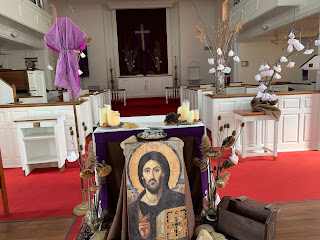
On the last Sunday after the Epiphany I offered the congregation two pieces of paper, one with the question, "This Lent I hope to cultivate..." and the other with the question, "This Lent I hope to let go of...". Then after the service we folded the papers into origami butterflies. I then wrapped each butterfly in tissue paper and hung them on our dried branches as cocoons. We'll open the cocoons for Easter and rehang the butterflies. On Pentecost we'll let them go, perhaps burning them and sending them up into the air?  I didn't read what people wrote, but as I folded some of the paper squares into butterflies I did see some of the responses, it was interesting to note how many said they hope to let go of "anger" in this season of Lent.  Anger. Anger was not my response, but I understand the desire to let go of anger. We live in an angry world today, so much anger all around us.  How do I let go of anger? Will I let go o...

A year of...

Image
One year ago, on February 14, which was the odd mix of secular and religious, of Valentine's Day AND Ash Wednesday, I made an impulsive, radical change. As I put on my alb, the robe that clergy in the Episcopal Church (and some others) wear as part of our worship vestments, I pondered my sermon. That's typical. But this time I thought, UGH! I cannot preach THIS sermon again. I mean it wasn't BAD exactly. It had all the right components for an Ash Wednesday sermon, a mediation on the invitation to observe a holy Lent. But oh was it dry. I just couldn't bear it. So I left my iPad behind and walked out to lead worship deciding that I would say whatever the Spirit led me to say in the sermon time. It was a little exciting. The congregation was small and intimate, so I felt like this would be okay. And, it was. I did the same thing on the first Sunday in Lent. Then the next Sunday. And now, every Sunday for the last year. No written manuscript. Well, once in a while I...